
From Beer Olympics to Fake Gin & Tonics
A Midlife Sobriety Experiment

Welcome to the Midlife Field Guide.
One year. Two Gen X friends. Countless personal experiments.
Can they figure out the meaning of midlife?
Hello Midlifers!
I’m very excited to share the experiment that triggered the idea for the Midlife Field Guide. It’s the first time I decided to do an extended experiment to see a) if I could do it and b) whether it would have a positive impact on my life.
This experiment is an attempt to see if I am able to remove alcohol from my life for an extended period of time, and if so, to find out what happens.
To understand why I undertook this particular challenge, it’s important to go back in time to explore my relationship with alcohol and why I was curious about whether I should change it.
Field Notes - Reflections on My Relationship with Alcohol
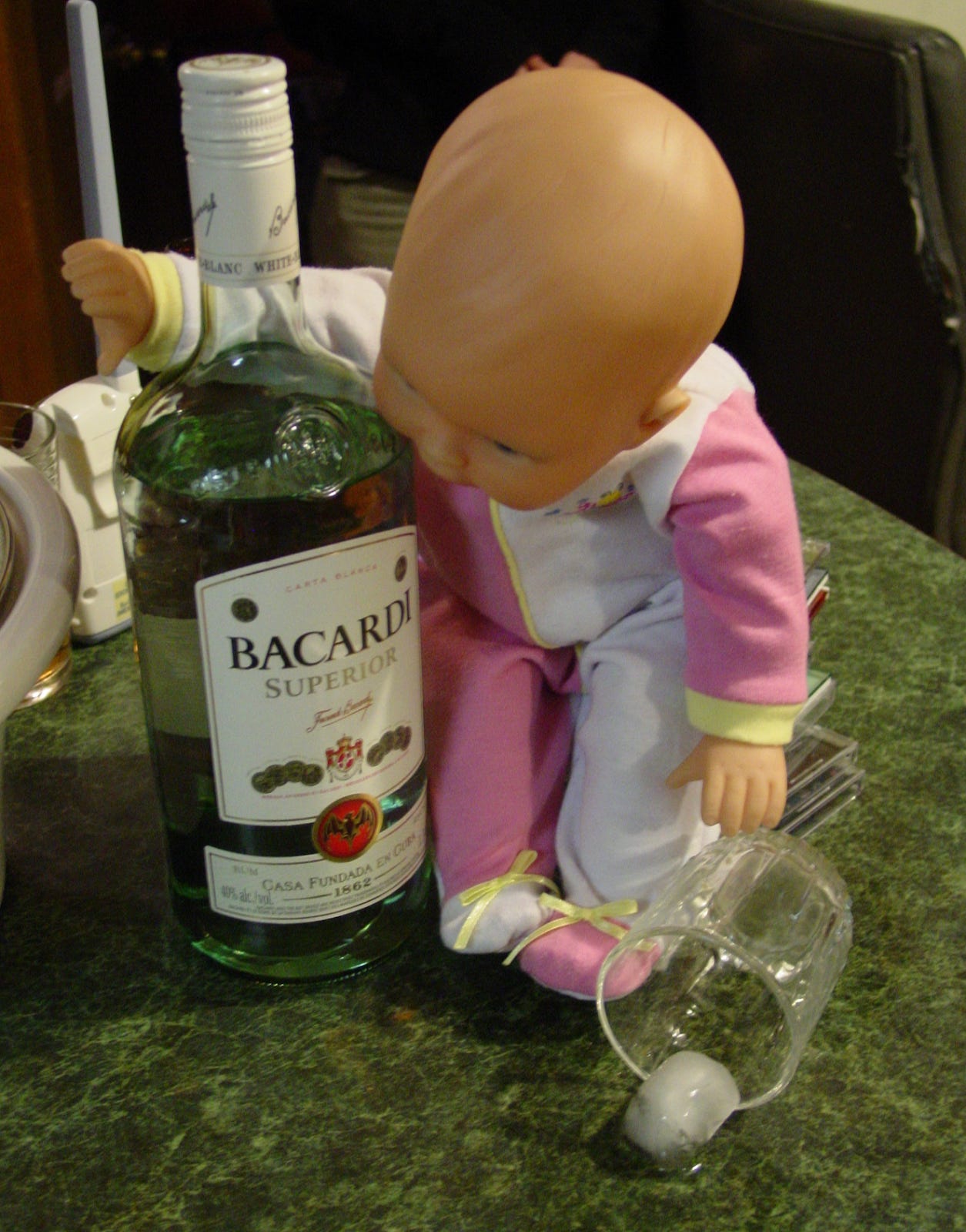
Alcohol has been a pretty regular part of my life since I was a teenager. Not in an especially problematic way, but I’ve been pouring rum and Cokes, Dark and Stormies, beer, and red wine into my gullet since high school.
Many of my early alcohol-related memories are not particularly endearing. In my last year of high school, I threw up in the back seat of my friend’s car. In a cruel and mortifying twist, my friend’s father happened to be my father’s boss. At my high school graduation, I joined a conversation with my dad and his boss, where his boss remarked, “So, I hear you had a technicolour yawn in the back of my Volvo.” #awkward
Soon after, I went to McGill University in Montreal. One of the supposed perks of going to McGill is that the drinking age in Quebec is only 18, so in my first year, I was legal to drink everywhere. Looking back on my first couple of years there, I struggle to imagine anything remotely similar to my experience still happening in any university today. At least I hope not! Let me explain…
From the first day I arrived on campus, the events at our residences were about one thing—drinking. Apparently, the year before I arrived, my residence made it onto The Late Show with David Letterman’s Top 10 Wildest University Residences. It lived up to the billing!
A few times a year, the Beer Olympics were held, with each residence floor fielding a drinking team to participate in a wide variety of competitive events, culminating in a giant “boat race.” In a boat race, there are two teams competing against each other. The teams line up with each person holding two beers in Solo cups. The race goes from one end of the line to the other and back again, with each member of a team slamming a beer as quickly as humanly possible before the next person can start their beer. There were ‘gifted’ drinkers who could open their throats and just pour an entire beer directly into their stomachs in about 2 seconds, and they were given the prestigious position of anchor at the end of the line, because they had to have their two beers back-to-back.
Then there was the endurance event: Century Club. It was a drinking competition where a group of people gathered in the residence common room to complete an alcoholic marathon: one shot of beer every minute for one hundred minutes. If you missed a minute, you were out. If you went to the bathroom, you were out. (Some people wore adult diapers to participate in this event, a crafty workaround to be sure…) And if you threw up, you were out. As fate would have it, I threw up in my 99th minute and was immediately christened the “Wayne Gretzky of Century Club.” #proudmoment
There were elected positions in the residences with the title, “Beer God.” Canada’s two biggest beer companies, Molson and Labatt, would stock a cavernous beer room in each residence, and the Beer God would be responsible for selling the beer at all hours to anyone who wanted it.
Each residence sold full-body painter suits with the residence logo stitched on the back. They were the de facto residence uniforms, and almost everyone in residence bought one of them. They were called “Puke Suits.”
All over Montreal, on almost any night of the week, you could spot groups of young students in red painter suits, drinking. There were $5 all-you-can-drink nights. There was a $7 all-you-can-eat-chili, all-you-can-drink-beer night, which included weekly betting on which five-minute window my friend would throw up in. (There was almost always a winner.)
It was insane. Back then, it was also normal. Kind of like blood-letting and leeches were ‘normal’ medical treatments at one time.
And ‘normal’ is important to note. When something is normal, it means everyone else is doing it. It’s the culture. There is peer pressure to be normal. Perhaps worse, when something is ‘normal,’ it implies that there is nothing wrong or concerning with that behaviour.
After university, the drinking toned down considerably. However, after setting the bar of ‘normal drinking’ that high, having a drink or two most nights felt downright responsible and healthy. And that is where I have stayed for decades. A drink or two most days, and more on vacations, special occasions, and weekends if you go out socially with others.
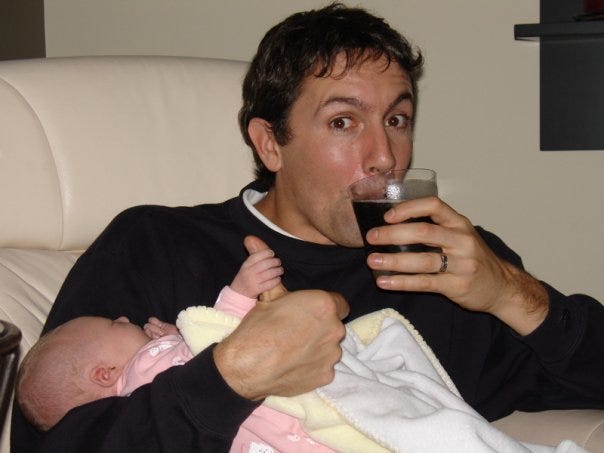
Then the pandemic hit. I found myself looking forward to my daily drink or two with anticipation. And there were a few more days a week that went beyond one or two. I was aware that I was using alcohol to relax and to mute my brain from thinking about the doom and gloom of the COVID lockdown, but relative to everything else that was going on in the world, a few more drinks didn’t seem to be the most important thing to worry about. I know I’m not the only one who found myself in this situation.
The pandemic was the first time I was aware that I was veering into unhealthy patterns, and the discomfort of that realization stuck with me like a bad hangover. As everything slowly began to return to normal, so did my alcohol consumption. In 2022, Andrew Huberman put out a podcast episode about alcohol, and almost everyone in my social circle was talking about it. The short message: zero amount of alcohol is good for you. This mirrored the controversial updated alcohol guidelines from Health Canada. No amount of alcohol is good for you.

Purely for health reasons, my wife Debbie began to cut her own alcohol consumption back significantly, even though she drank less and less often than I did. More than once, she suggested that I should consider doing the same thing. It gnawed at me. I knew I should do it, but I couldn’t muster the motivation to hop onto the wagon.
Then, last summer, a pattern started developing. In random conversations with friends and acquaintances, they would casually drop that they had stopped drinking entirely.
One of my friends, Bob Kronbauer, posted about his decision to stop drinking publicly, and it was truly inspiring. At a conference in Copenhagen this winter, I had one of the best and most memorable meals of my life with a friend from the podcasting industry, who told me that he had stopped drinking alcohol several years ago. We spent a good chunk of the dinner talking about it, while I sipped guiltily on a gin and tonic.
I have a great friend, Jordan Kawchuk, who is one of the most talented, creative, and wonderful humans I know, who has struggled with Alcohol Use Disorder for a long time. He’s been writing about it publicly for the last couple of years, and his vulnerability and brilliant storytelling have deeply impacted me and made me clearly see how our society celebrates and normalizes alcohol consumption at almost every turn.
He wrote an essay about Dry January, exploring the differences between being dry for a month and being permanently sober. It went viral. His writing regularly forced me to think about my own relationship with alcohol, and it made me curious about whether I could cut it out of my life entirely.
The seed was planted. I was definitely sober-curious and wanted to know more.
The final straw was meeting up with an old friend from McGill in January. I hadn’t seen him in years and years. And he was drinking like we were still at McGill, albeit instead of a puke suit. it was Hugo Boss. Drink after drink after drink. I couldn’t keep up. And I didn’t want to. That night, a switch flipped.
I don’t want to do this anymore.
The Experiment
Steve will abstain from drinking any form of alcohol for 6 months.
Why ZERO alcohol? Why not moderation, like weekends only?
A few reasons. I considered just dialling back, but there are simply too many exceptions, too much peer pressure, and too many potential self-justified loopholes. I think the experiment will be easier if I cut it out entirely.
I also think that if I’m going to do an extended experiment, a full commitment will teach me more than moderation will.
The Hypothesis
This is going to be hard, for several reasons:
It’s going to be hard at home, because there are habit-driving cues all over our house. The cupboard in the kitchen that houses the booze. The little wine fridge in our basement that was given to us because it wheezes whenever the compressor comes on. The copper mugs that I have Dark and Stormies in.
It’s going to be hard with family, because having a drink or a glass of wine with my parents is the status quo. I have a feeling I will be pleasantly ridiculed, with some mild pressure to have drinks during family visits.
It’s going to be hard on vacations, because I associate having drinks with a fun vacation, especially if it’s warm and sunny. For me, some of the joy of a vacation is a vacation from being responsible, which means that I can relax and… have more alcohol than usual.
It’s going to be hard not drinking around others who are drinking. Most of the social outings I’m part of involve alcohol. Whether it’s an evening with other couples that is filled with wine, a weekend with a few guys that involves cards, sports, and booze, a vacation in the Okanagan that usually includes a wine tasting (below), or just a post-work drink with colleagues, it’s going to be awkward not drinking and having to explain it to people. This is the part I’m dreading the most. Becoming an outcast.
When it comes to changing drinking habits and a personal relationship with alcohol, it’s important for me to acknowledge that “hard” is relative. Did I binge drink at McGill in unhealthy ways? Absolutely. So did almost everyone else I knew at McGill at that time. Have I continued with it since leaving McGill? No. Has alcohol use negatively affected my life in any way? No, it has not.
So, relative to others like Jordan, who have serious illnesses tied to alcohol, and where alcohol use significantly affects their lives, I have it very easy.
That doesn’t mean it’s not still a worthwhile experiment to try and find out what happens if I can stop pouring poison into myself every night. ☠️🍺🍷
Observations
February 1, 2025. Day one of no alcohol.
I am a nerd. I am a habit psychology junkie. I was part of an early beta test that became the book Tiny Habits. I voraciously read Atomic Habits as soon as it came out and loved it.
I knew that if I wanted to stop alcohol, I would have to make it hard to consume alcohol. I would have to figure out what cues my alcohol consumption—the triggers lurking in my environment—and remove them. And I would also have to make it easy to choose healthier options.
So I packed up all the alcohol in the house and hid it away in the basement in a box.
Next, I went shopping for replacement options. I found a place called Welk’s, only a few blocks from my home, that has a sizeable mocktail section in the very back of their store. Welk’s is one of those weird stores that curates interesting, yet random stuff. You can get a frying pan or a board game, a candle or a pair of socks, a fancy Moleskine notebook… or a six-pack of non-alcoholic gin and tonics.
I loaded up and filled our fridge with fake gin and tonics, fake Moscow Mules, fake Palomas, fake beer, and fake wine.
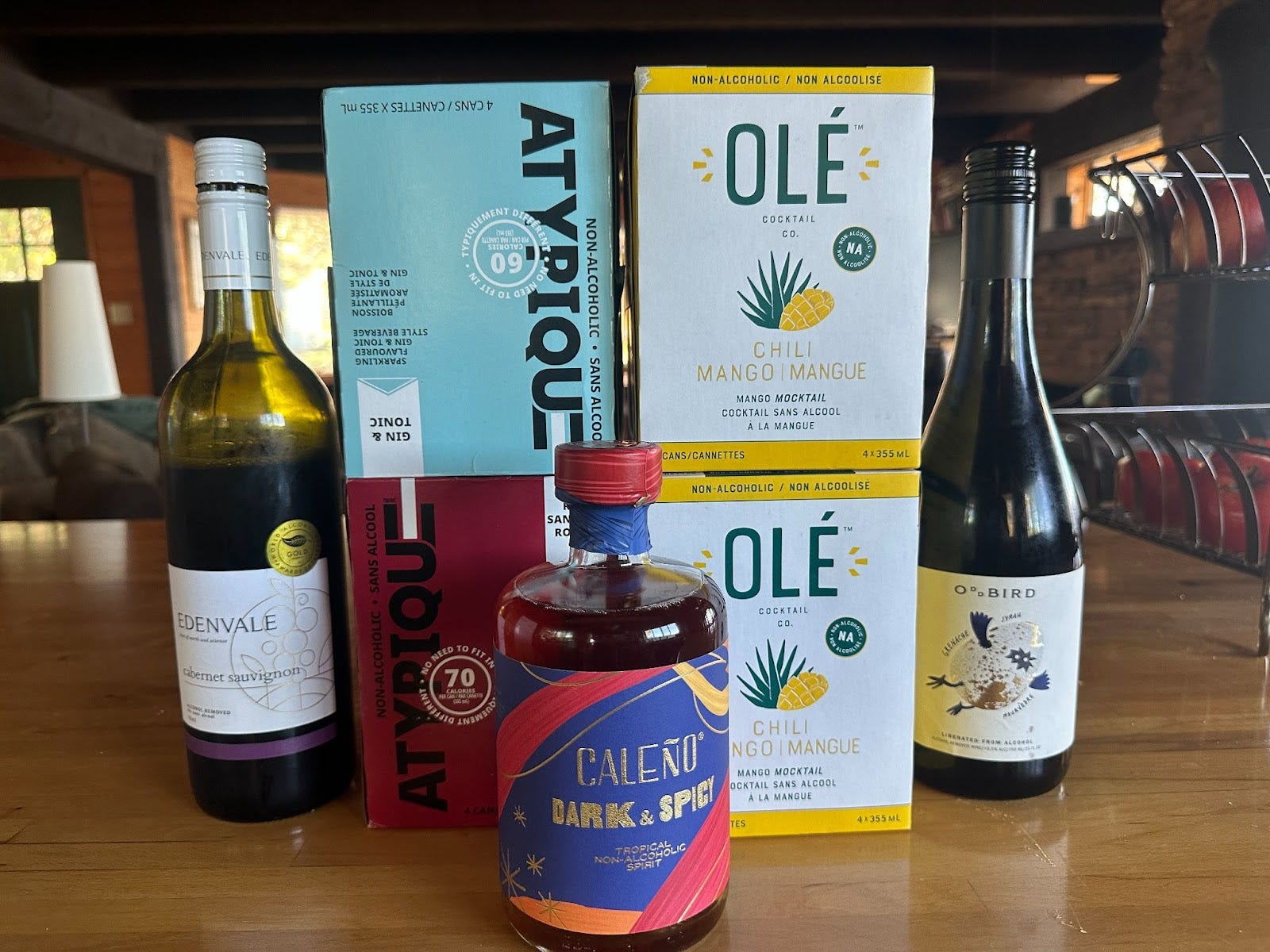
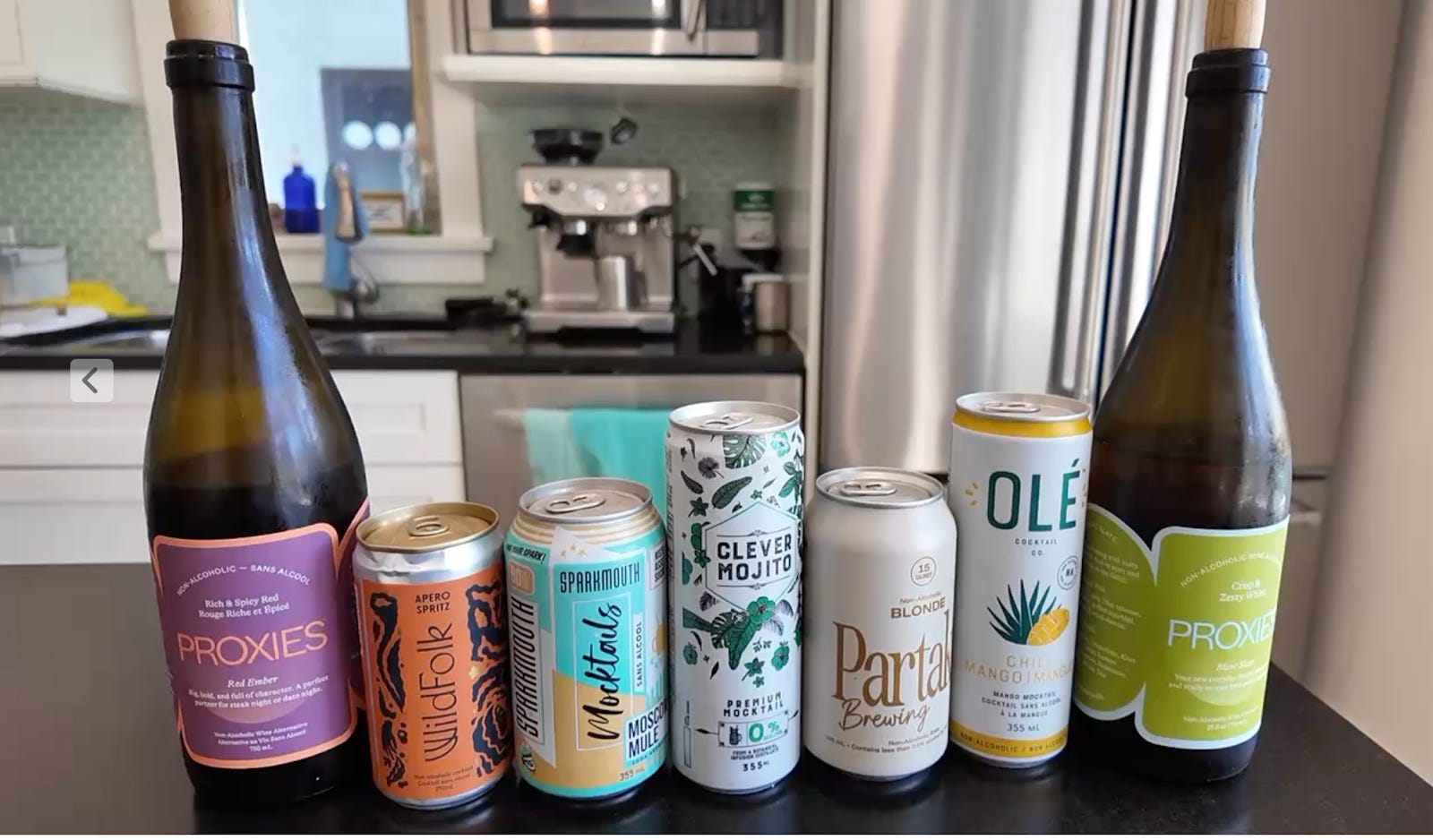
At 6pm, I cracked a can of Partake Blonde non-alcoholic beer. About an hour later, I poured myself a fake gin and tonic from Aelo. Both were terrific! I kept sampling more of the new stash. Suddenly, I was in the middle of my first non-alcoholic bender. I might just be a liquor-free lush!
I went to bed excited that this adventure was officially underway.
Am I really doing this? Am I really going to commit to this for six months???
I am!
How did the six-month experiment go? The answer will be in the next instalment of this experiment, coming soon.
Spoiler alert: resisting alcohol itself is a lot easier than resisting peer and societal pressure to drink alcohol.
I’m so curious about your reactions to this experiment and these stories.
Have any of you tried an extended period without alcohol?
Have you been rethinking your relationship with it at all?
And have you found any great mocktails, fake beers, or fake wines I should know about?
Thanks for reading. I can’t wait to share the updates about this experiment with you soon!
Steve
Part two: Never Trust Anyone Who Doesn’t Drink
Part three: This Is Your Brain On No Booze
My relationship with alcohol has seemed comparatively "light" until I wrote this... now I'm thinking otherwise.
I pretty much avoided it entirely in high school, but definitely experienced the peer pressure (and succumbed to it) in college, as well as at my first jobs. My first full-time job was at a tech startup, with a very young demographic, and there was a heavy drinking culture. Towards the end of it, I was working overseas in Hong Kong, and expats in Hong Kong drink; you don't have a car and you don't have a kitchen, so going out and drinking is just what you do. I learned all about drinking to excess there, and the perils that came with it. I never really developed a habit of drinking every day, nor did I feel any cravings around alcohol, but I did tend to drink a LOT on social occasions. Once I was in California, I remember going on wine tasting trips where had I been the designated driver, we'd have needed a taxi. I recall one night I literally slept in my car because I knew it wasn't going to be safe to drive for hours, and I didn't want to leave my car in the neighbourhood.
When we were pregnant (and while the kid was nursing), I stopped drinking in solidarity with my spouse, and I realized having a perfectly good excuse to not drink in social settings made it really easy to just not drink at all. I will say, once we got back to drinking, we relished the experience, but I noticed I wasn't drinking nearly as much at a sitting. Still, social drinking became the norm again.
Over time, I started drinking more, and I got into Scotch to the point where I had relationships with people where we'd go out and try various Scotches, ending the evening usually quite wasted. At the work place, drinking was normalized so much that people had fridges in their offices stocked with beer and hard liquor, and I decided I'd "fit in". I mostly stocked up on Scotch, and periodically on a Friday we'd have a drink or two, but oddly I accumulated bottles faster than I drained them, so drinking at work was pretty limited.... except for work parties. Man, they partied hard, and I joined in. I recall one night it got so rough I vomited (which I basically never do even when horribly sick) all over someone else's bathroom (fortunately at a hotel, so I had some help from the hotel cleaning crew cleaning it up). I recall that was the point where I realized I should limit my drinking at work events (up until then, it never felt like a "problem").
When the pandemic hit, I went to the office, retrieved all the accumulated Scotch, and brought it home. To help with morale during the pandemic, we decided to have an end of the day "Zoom happy hour" where we'd attempt to recreate a virtual water cooler that was "alcohol enhanced". I felt an obligation to participate, and I worked my way through that accumulated collection. That was when I discovered Drizly, and which got me to start ordering alcohol almost as a habit. After a while though, that whole scene got old, and I just stopped drinking almost entirely. I never made a decision to quit; it just stopped having much appeal.
I still drink, but whenever I have a check up and they ask me when I last drank, I have this startling realization that it has been weeks or months since I last drank. We have a couple of bottles of wine in the house, which we occasionally will open up and enjoy. I still have a backlog of Scotch I'm *very* slowly working through that dates back to the pandemic, but I keep "forgetting" that having a drink in the evening is an option. I have one social group that I hang out with where we have dinner, usually with a couple of beers, and there's a couple of tech interest groups I participate in where I might have a beer since it is free, but even on those occasions it's not a given. If it's been a really rough day, I might go out and commiserate with friends over copious alcohol, but that's happened like.. twice in the past three years? Interestingly, a lot of my friends have started to really limit or even eliminate their drinking. A few have struggled with alcohol abuse, but mostly it is because their hangovers have gotten worse and those consequences don't feel worth it. While my body is definitely no longer that of the youth I once was, by some quirk of fate (probably a habit of drinking a lot of water), I have rarely suffered hangovers in my life, and if anything seem less likely to suffer ill effects these days. So that's not my incentive. I think most of my drinking has been motivated by the habits of those I socialize with, and if they're not drinking, I'm certainly not drinking. I haven't seriously considered stopping drinking altogether, but it doesn't feel like it'd be that hard or that much of a lifestyle change at this point.
Steve, once again, I find myself feeling like your twin. Especially when it comes to the university alcohol experience. My experience at UBC was virtually identical to yours. Being Vancouver, my “Olympics” had more physical activity involved. A 2 or 3 km run put on by the Agriculture faculty, where you had to drink a full beer every 100 m. I made it 1 km before puking my guts out. And I looked forward to it every year! 🤪
I cut my alcohol content way down about 5 years ago. For me, the trigger was work. My job required lots of dinners out. Big banquets with bad wine. One on one client dinners with really good wine. The common factor - peer pressure, and free booze, no barriers to having just one more. It wasn’t that I was drinking to excess. Most times, I would just have a glass or two. But it slowed me down and one day it just hit me that I wasn’t even thinking when I said yes to that bad glass of wine at the banquet. Now, I order my Partake Blonde or glass of Perrier and never think twice. And I have a better shot at kicking your butt on the tennis court the next morning as a result - that became a way bigger plus to me than having to handle any peer pressure the night before!