
Don’t Measure What Matters.
An experiment in turning off every scoreboard in my life.

Welcome to the Midlife Field Guide.
One year.
Two Gen X friends.
Countless personal life experiments.
Can they figure out the meaning of midlife?
Subscribe for free!
Happy 2026, Midlifers!
On January 1st, I was ready to start the year with a fresh outlook. I popped on a podcast episode promising fresh insight into finding meaning in life—Arthur C. Brooks on the Tim Ferriss podcast.
I couldn’t make it through the episode. I had to turn it off halfway through.
I’m nervous to tell you why, because I’m part of the problem…
I’ve been a somewhat compulsive data/measurement/tracking productivity obsessive for much of my life. I have lived the “Quantified Self” to one degree or another for a long time. Counting steps. Tracking sleep. Optimizing workouts. Analyzing stats.
I’ve worn an Apple Watch every day for years and years and years. I got an Oura ring in 2020 and have worn it daily for almost 6 years now. I’ve had an unhealthy relationship with “productivity” and trying to get as much done as humanly possible every day. I have an endless backlog of tasks in my “To Do” lists, all organized in Kanban style on Trello and rooted in the David Allen “Getting Things Done” methodology. (This is why everything Oliver Burkeman writes about being a recovering productivity addict resonates so deeply with me. Thank you, Oliver!)
Every day, through all these devices and systems, I have ended up with a series of targets, numbers, scores, or systems that, essentially, tell me whether or not I’ve had a successful day.
Over the years, I’ve become adept at “achieving” these types of successful days. There has been a major downside to this relentless tracking and optimization, though:
I have a really hard time relaxing.
Ever.
I always feel like I should be doing something—anything!—to move things forward, to get more things done, to raise the quality bar further.
And listening to Arthur C. Brooks talk to Tim Ferriss, I became deeply, deeply annoyed. I literally could not keep listening. And I knew instantly what I needed to do to start my year in a new, liberating way.
Stop. Measuring. Everything.
I’ve decided to spend January 2026 turning off every scoreboard in my life to see what happens.
Here’s why…
The Arthur C. Brooks Podcast Incident
January 1, 2026
Yesterday, I saw that Arthur C. Brooks was a guest on the Tim Ferriss podcast. As an author of the Midlife Field Guide and a fan of Brooks’ pandemic-era book, From Strength to Strength, I was curious to hear his thoughts on finding meaning in your life.

What I got is not what I expected or wanted.
I probably should have known better—right off the top, there is an ominous warning of what lies ahead. Tim tells Arthur, “Glad to see the vascularity in your arms is still visible even through the long sleeve shirt.”
Pardon?
The episode begins with an extended examination of Brooks’ morning routine, which could almost certainly pass as a parody of modern masculinity. I am going to summarize the episode up until the point I turned it off, and you can judge for yourself whether this is truly a path to meaning and happiness.
Arthur starts every day at 4:30 am with the Brahmamuhurta ritual, rising 96 minutes before sunrise to optimize his productivity and creativity. There is a detailed discussion of his hour-long workout and Arthur shares that “the most important room in my house is the gym.”
To make the most of every waking second (and with a 4:30 am wake-up, Arthur has more waking seconds than the rest of us), he maximizes productivity by stacking his thinking and exercise together, working out sans headphones. “That’s your most creative time,” says Arthur. “That’s like taking an hour-long shower. You get your best ideas if you work out without headphones.”
Brooks has logged every workout he’s done since his 30s. He is 61. He can track his own heart rate without a monitor, because “120 beats per minute is a really, really easy thing to ascertain, because I’m an old musician. That’s the speed of a Sousa march.”
Yes, Arthur! This sounds great. I will first study Sousa marches until I subconsciously absorb the 120 beats-per-minute cadence, and then develop the ability to match that pace to my own heart rate. That sounds much easier than wearing a heart rate monitor.
Arthur’s workout is followed by attending daily 30-minute Mass to connect with his spirituality, which he dubs ‘The Holy Half Hour.’ Then the nutrition begins. He ingests an unusually high dose of 15-20 grams of creatine a day, explaining that the first 5 grams are for “muscle protein synthesis or volumization of muscles” and the rest is to neurologically bank four hours of concentration, “to set myself up for optimal creativity.”
Even coffee has an unusual role in his life. He doesn’t use coffee to wake up, but to focus. The role of caffeine is “circulating adenosine to metabolize and to clear endogenously,” whatever that means. I think we can all relate when Arthur says he wants “plenty of open parking spots for the adenosine receptors, that I can then fill two to three hours after I wake up with caffeine.”
What does this mean? And what does this have to do with the meaning of life?
Brooks is a Professor of Happiness at Harvard. Yet this does not feel like a relaxed individual. It feels like someone who is confident they have life figured out, with every single second rigidly optimized for maximum yield. This feels like someone desperately trying to cheat death, a recurring and worrying theme in modern bro culture.
This is the quote that made me turn off the episode:
“I’m most comfortable when I’m sub-10 body fat.”
This is not repeatable behaviour for 99.9% of humanity. This is the sort of stuff that makes all of us feel worse about ourselves, not better. These are the examples that make the rest of us give up on happiness, healthiness, and meaning.
If I’m on the weirdly obsessive side and all this sounds impossibly unrealistic and unhealthy to me, I can’t imagine what this must sound like to people who are “normal” on the data/tracking/productivity scale.
TLDR: If this over-the-top shit is what we have to do to be happy, it’s just not possible… or worth it.
Miriam Toews on Living Forever
I have been reading Miriam Toews’ brilliant memoir, A Truce That Is Not Peace, and this jumped out at me as a perfect indictment of modern masculine culture in 2026:
“I think of the words written on the wall of the women’s washroom in the recreation centre at the park, Trinity Bellwoods, near my home. Read that to me, said my grandson.
Only assholes wanna live forever, I said.
Only assholes wanna live forever? he said.
Later, I saw a guy getting into his car across the street from me wearing a T-shirt that said, Assholes Never Die.”
Just sayin’…
It’s Not Just Arthur. It’s Everywhere.
There is something tangibly and toxically masculine about morning routines and conversations like this. It’s about trying to dominate and control elements that are, by definition, not controllable… like aging and death.
There is no post-death scoreboard to enjoy. You can’t ‘win’ life. In fact, I’m pretty sure that manically trying to ‘win’ life and conquer death guarantees that you’re actually missing most of your actual life.
And yet, part of the reason I had such a strong reaction to Brooks’ morning routine is that I recognize too much of myself in his ritualized attempts at immortality. Obviously, I’m not doing things at his level, though—people like Arthur keep pushing the bar higher and crazier to the point where it is just… impossible. And ridiculous.
I know I’m not alone. This type of content is like the Siren’s Song to so many Type A nutters like me. I was genuinely disturbed when I realized thousands of people are going to listen to the podcast and adopt these protocols as a new definition of success for their lives. They will assume that Arthur has life figured out and that by copying his morning routine, they will, too. And it won’t work.
In that moment, I realized that I never want to live by someone else’s scoreboard again. And, at the same time, I recognized clearly that I have been doing exactly that for a long, long time. All of it done in the belief that measuring and optimizing everything will make my life… better? And, ironically, it generally makes me feel worse about myself.
It’s exhausting. So I’m done. (For a month, anyway.)
I don’t mean to pick on Arthur. This stuff is everywhere. Our entire culture is obsessed with the optimization of everything. Everything is a scoreboard.
What Does This Have To Do With Midlife?
Many of you are likely starting New Year’s Resolutions that involve capturing, measuring, and analyzing data about your lives. It might be weight. It might be fitness levels. It might be words written daily for your novel. It might be your productivity!
Peter Drucker famously wrote, “What gets measured, gets managed.” It’s quoted all the time.
So if it matters, you should measure it.
Or… should you?
One of the core principles in my book, Earn It, is to Do the Opposite. And I am ready to Do The Opposite when it comes to ‘measure what matters.’
In fact, the full Peter Drucker quote is less well-known:
"What gets measured gets managed—even when it's pointless to measure and manage it, and even if it harms the purpose of the organization to do so.”
Baboom!
My new mantra for 2026 and the focus of my first new experiment of the year is “Don’t Measure What Matters.”
My Desired Outcome
I don’t want every activity to be a means to an end. I’d like to just enjoy them while I’m doing them. I don’t want to judge every activity or everything I do through the lens of “Was it successful?” Or “Am I on track?” Or “Did I improve?” Or “How am I comparing to others?”
I want to just live my life and enjoy my activities without turning everything into a competition. I don’t want to evaluate every activity in my life through someone else’s scoreboard.
If something really matters to me, I don’t want to measure it anymore.
My Data, Not My Metrics
I have collected too much data for too long, in too many ways, about too many things. I used to think gathering as much data as possible was smart and helpful.
Now, I’m not so sure. None of these measurements is really of MY choosing. They are chosen by companies that want me to track these things. They want me to check my data every single day.
Their scores and scoreboards and dashboards and infographics and Year In Review data visualizations are all shaping my behaviour. Their scores are shaping my self-worth. Their scores are shaping my life.
When I pause and reflect, I realize that almost everything in my life has been turned into a competition or a game by companies eager to keep me using their products. And they have the power to determine how I feel about myself on a daily basis.
My sleep score stinks? I’d better rectify that and figure out why. Anxiety.
My Substack post is underperforming? I’d better figure out why and start questioning myself. Anxiety.
My heart rate is higher than my friend’s? I’d better stew about whether there is anything wrong with me physically and whether there is anything I should be doing about it. Anxiety. Shame.
The list of data that makes me feel worse about myself goes on and on.
I’m curious to find out what happens if I turn it all off for a month.
The Experiment: Arthur C. Brooks IS Making Me Change My Life
I turned off the Tim Ferriss podcast and knew exactly what I needed to do this January to kick off 2026 for the Midlife Field Guide.
No. More. Scoreboards.
I’m going to stop measuring… everything. (***Almost)
For the entire month of January 2026.
No more steps to count.
No more rings to close.
No more sleep to track.
No more follower counts to compare.
No more open-rates to obsess over.
Questioning The Data
Most of the time, the data tells me what I already know.
Every single day, I wake up and see that I have had a high degree of restlessness in my sleep. Every single day, I get suggestions about how to reduce restlessness during the night. Nothing works.
So for at least six years, I have started every day feeling like I’ve failed at sleep and need to figure out how to fix it.
How has sleep become something that determines my self-worth? Why do I feel like I need to be ‘successful’ at… sleeping?
When the data is not the same as usual, there is rarely anything I can do about it, and there is rarely any change I need to make. (Looks like running a 10km race has lowered my ‘Readiness’ score the following day. Shocker!)
So if I’m learning nothing new and there is nothing I can do to change the data, why do I track it?
After years of daily data, my hypothesis is that I have already learned what I need to learn. My hunch is that the data is no longer driving better decision-making, and I should question why I continue to track it obsessively.
If the data makes me feel worse, is this capturing and analyzing actually having a negative effect on my life?
I’m not opposed to being curious about my health or well-being. But the volume of data and data-checking feels… absurd. Why not monthly? Or quarterly? Make sure I’m on track, without obsessing over it daily or hourly.
So no data. No tracking. No scoreboards.
If you’re looking for me, I’ll be the one wandering around mumbling to myself like a conspiracy theorist, “Don’t Measure What Matters!”
Day One - January 1, 2026
I am nervous to do this. I know this is incredibly lame, but I have done this for so long that it feels quite stressful to willfully create an empty gap in the years and years of data.
First day with no Apple Watch for years and years and years. My wrist feels empty and light. I twist my hand to look at the time and see only a tan mark where the watch usually resides.
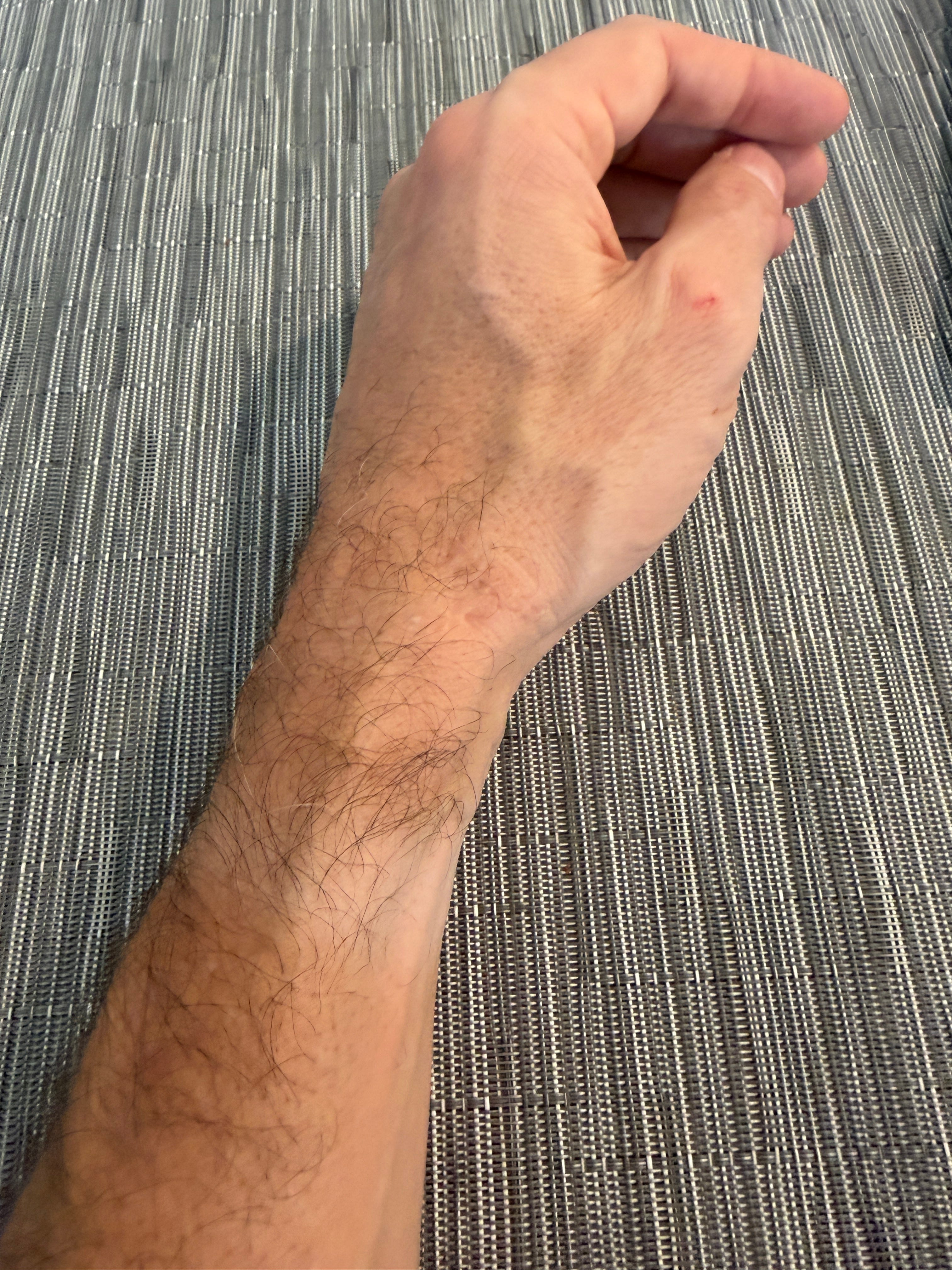
First day with no Oura Ring since the pandemic. My thumb keeps looking for the ring to twirl, but finds only skin and a callus.
I am panicked and also feeling a bit liberated. Much like ending my Wordle streak last summer, it feels daunting and stressful to end a long streak and consistent habit… until you do it. After you break the streak, you realize that it’s not bad at all.
I took a long walk on New Year’s Day along the beach. For the first time in forever, I have no idea how far I walked, how many steps I took, what my average time/minute was, or anything else. I did not close my Exercise ring.
I walked because I enjoyed being outside by the ocean. Don’t measure what matters.
I went to sleep without my Oura Ring on for the first time in forever. I got up this morning and had no sleep score to check. I paid more attention to how I am feeling. I had an okay sleep, and I’m 99% sure the Oura Ring would have told me the same thing.
I slept because I was tired. I woke up because I was rested. Don’t measure what matters.
I played tennis and did not turn on my Apple Watch to track it for the first time in years. I have no idea if my Move ring is closed, how many calories I burned, what my average heart rate was, or anything else.
I played tennis because I love sports with friends. Don’t measure what matters.
And you know what happened by not measuring anything on Day One? Nothing.
It didn’t matter. At all.
No matter how I sleep, I will feel how I feel in the morning. My body will know what I am up for doing and what I don’t feel like doing.
Also, I’m having fun playing tennis, not using tennis as a means to some other end.
It’s early days, but I have a feeling this will be as fruitful and meaningful as my Phone Fight. Stay tuned!
Thanks for reading—let me know if you have any suggestions for data and measurement to ignore this month.
Here's my challenge to any of you interested in this experiment: What's one scoreboard you could turn off this month? Just for January. Just to see what happens when you stop letting a company's algorithm determine whether you had a 'good' day. Hit reply or leave a comment with what you’ll stop measuring.
Also, we will be announcing the winners of the Midlife Book Giveaway soon—go leave a comment on this post if you want to be entered.
Coming up soon on the Midlife Field Guide… Part 2 of my Stand-Up Comedy adventure with my 23-year-old daughter and Geoff begins exploring activities he hated in his childhood. How will the first trial runs of comedy on stage go? And will Geoff find a way to enjoy team-based sports? Stay tuned!
Steve
(***The one caveat this month. I have resumed running again, training for the Vancouver First Half marathon on February 8th. I am going to put on my Apple Watch for my training to know how far and how fast to run because I’ve never done this before and need help. 😜)
Love this! I ran a similar experiment a few years back. I "knew" how much I can eat, how much activity led to a "good sleep score", etc. etc... I felt that I'd finally dialled in my routine enough to trust taking off the Apple Watch and buying a simple round watch with a dial and hands. I could sleep because I was tired and wake because I was rested. I might work out or walk (or not) because if felt like a good time. I would journal one day, and play guitar with coffee the next. It was like some sort of permanent vacation from the worst boss ever - me!
It reminds me of my latent fantasy - a life free of clocks and calendars. Those last worldly metrics and measurements that I often react to with anxiety and panic.
I have put my smart watch back on and do track my health again. However, like coming off a long fast, this time the healthy behaviour is the relationship I have with my personal data consumption.
Good luck, and looking forward to hearing your progress!
I feel this struggle, Steve! I am much less of a tracker than I used to be, but I've been on a quest to "dumb" my phone for about a year now. My challenge, and I'm curious if you share this, is that failing to record the metrics didn't stop the narrative. I actually journaled this morning about how I think I may be incapable of real rest ("Am I using this time wisely? Are my skills in this hobby I enjoy improving? Am I breathing deeply enough to benefit from this 'rest'?" I kid you not.). I can't even read a book without dissecting the writing and narrative. The thing that has helped me is Kate Bowler's counterpoint to optimizing life: There's no cure for being human. We cannot optimize ourselves out of the messiness of living no matter how hard we try. No longer tracking life has allowed me to zoom out and embrace it. Best of luck, and I look forward to hearing more about your experience.